Showing posts with label Theatre Review. Show all posts

Tuesday, February 28, 2012

Theatre Review : The Changeling by Thomas Middleton and Thomas Rowley - Young Vic (dir Joe Hill-Gibbins 6/2/12)

Charlotte Lucas and Jessica Raine 
There's something very modern about blood-soaked Jacobean tragedies that make them so very condusive to modern adaptations. Maybe its the moral ambiguity surrounding the heroes or the amorality of the villains that resonates so very well with our post-modern age.

In The Changeling by Thomas Middleton and William Rowley, Beatrice-Joanna (Jessica Raine)  is being forced into loveless marriage to Alonso (Duncan Wisbey), so she asks her lover Alsemero (Kobna Holbrook-Smith) to despatch her husband-to-be. He demurs, but scrofulus De Flores (Daniel Cerqueira)  has the hots for Beatrice and is willing to do anything for her. His price is her virtue which he duly takes, leaving Beatrice with a problem on her eventual wedding-night. Fortunately, she can fall back on that old renaissance stand-by beloved of Shakespeare, the bed trick, though unfortunately her maid Diaphanta (Charlotte Lucas) enjoys performing the trick a bit too well.

This is The Changeling supercharged - urgent, sexy and messy. The audience are right on top of the performers in the Young Vic's Jerwood space, and can feel the scratches of this tactile production. Beatrice is sassy, self-willed, vulnerable. You can see why she has so many men in her thrall. De Florio breathes heavily as he watches her, his lank hair dropping greasily over his scabby face. Beatrice can't hide her repulsion as she realises she must kiss him in order to get her way. Meanwhile in the subplot,  Henry Lloyd-Hughes as Antonio dons madman's guise to gain access to doctor Alibius's wife Isabella (Charlotte Lucas again), incarcerated in a madhouse under the lecherous eye of Alex Beckett as Lollio, rubbing his truncheon lubriciously.

Come the bed-trick on the wedding night, Alonso and Diaphanta smear each other with raspberry jelly (as one does), the resulting sheets giving notice of the truth of Beatrice's virginity. But as everything starts to unravel, this wonderful production finally starts to lose its grip as the jelly starts to fly courtesy of those wronged (which by now was the majority of the cast). It was the only bum note in the evening, as such a taut production required a  denouement which was earthier, more tangible, slightly less symbolic. Up until that point I had enjoyed this gripping production immensely, and some sniggers from the audience suggested that my doubts were not alone. But full marks to Director Joe Hill-Gibbins for a production that shocked, challenged but above all entertained right the way to the end.


Sunday, February 05, 2012

Theatre Review : She Stoops to Conquer by Oliver Goldsmith - Olivier Theatre (dir Jamie Lloyd 30/1/12)

The plot of She Stoops to Conquer is as insanely clever as theatre has ever devised - Mr Hardcastle (Steve Pemberton) would like his daughter to be married to Marlow, the son of an old friend, so invites him to his house. However, Hardcastle's loutish step-son Toby Lumpkin (David Fynn) intercepts him, and tells him that Hardcastle's home where he will stay the night is in fact an inn. Marlow has an unusual impediment, in that he can freely chat up women of a lower class but is completely tongue-tied in the presence of ladies of quality. Which makes him fortunate to think that he is staying in an inn, and that Hardcastle's daughter Kate (Katherine Kelly) is a serving girl.

Goldsmith's satire is very effective. In mistaking Hardcastle's house for an Inn, and Hardcastle for an Innkeeper, Marlow and his companion Hastings (John Heffernan) treat both with the disrespect to be expected at the time, and it is still today fresh and funny. As is typical in plays of the time, Hardcastle's wife (overplayed deliciously by Sophie Thompson) has aspirations above her country station, and all the humour derives from the confusions of upper versus lower class, and rural simplicity versus urban sophistication.

The humour is drawn out by the cast quite rightly overplaying everything - this is not a play to benefit from subtlety. Marlow switches easily from tongue-tied lover to skirt-chasing rogue, whilst Kate moves with equal facility from charming young daughter to sluttish serving girl.

Jamie Lloyd's production uses the Olivier's revolving stage to great effect as he switches seamlessly from inside to outside Hardcastle Hall, the only downside being the rather twee song and dance numbers which fill the gaps during the set changes.

After a slow start (this was the first preview) both cast and audience got into the rhythms of the humour and the cast seemed to feed on the laughs they were receiving from the stalls. By the end, part of the audience was on its feet, and, if that was perhaps an overreaction, it was certainly a most enjoyable production of a play that still retains its freshness more than 200 years since its first production.

Theatre Review : The Madness of George III by Alan Bennett - Apollo Theatre (dir Christopher Luscombe 26/1/12)

King George III, one of the more decent monarchs to have graced the British throne, was unfortunate to suffer from a recurring illness - probably porphyria - which manifested itself in prolonged outbursts of what appeared to be madness. Alan Bennett's play studies the impact on the King of the first such outbreak, the barbaric methods used to try to cure it and how it affected the court politics of the day. Being written by Alan Bennett, it is a story told with humour, pathos and sensitivity, but also hard-edged and shocking.

Of course, most people are familiar with this story today, largely as a result of the success of this play when it was first staged.There is a risk in reviving such a well-loved work, which has successfully made the transition into an equally well-loved film with a much-missed national treasure in the title role. The lead part is so pivotal that comparisons with Nigel Hawthorne are unavoidable - yet such is the power of David Haig's performance as George III that within a few minutes I was totally involved in his performance and not attempting to make any comparisons.

I was once in a restaurant before a show and David Haig was eating with some companions on a table nearby, and he is one of these people whose charisma fills the room. Yet in many of the roles in which I have seen at the theatre or on television, he has played characters who are either bumptious and officious, or downtrodden. This may be testament to his acting ability, but neither types really allow his natural charisma to shine through.

This role, however, has put that right. Haig dominates the stage as a monarch should, even one beset by this dreadful malady, which makes his suffering as he loses his reason and is beset by blistering and binding by his doctors all the more poignant. He is well-supported by the large cast, especially Beatie Edney in the unattractive role of the monarch's plain but much-loved wife, Queen Charlotte and by Clive Francis as Dr Francis Willis.

The play itself looks a bit baggy in places. There is too much of Fox and Pitt and the machinations of the would-be Prince Regent, too much history lesson and not enough characterisation of the lesser roles. Parallels with contemporary politics are spurious and forced. But this is all about one man,  and the play comes alive when contemplating the true nature of kinghood, born to the purple, right down to his porphyria-stained urine.


Wednesday, December 21, 2011

Theatre Review : Hamlet - Young Vic (dir Ian Rickson 19/12/12)

My earliest serious theatregoing was to the Citizens Theatre in Glasgow in the 1980s when it was led by magnificent trio of Giles Havergal, Robert David MacDonald and Philip Prowse, to which I wholly attribute my love of adventurous, iconoclastic productions and a good working knowledge of Brecht. I remember back around 1983 going to see a production of Hamlet, directed by Havergal and Prowse, set in a lunatic asylum, with the play being acted as group therapy. It may even have been the first time I had seen Hamlet live, but we had studied it at school so I was familiar with the text; however, I was disappointed with the production. As everyone was acting out the play as therapy, then the key question of how and when and to what extent Hamlet was mad was blurred as he was - by definintion - mad to start off with. Having saddled itself with the concept, the play itself then struggled to break free of it


So it was with a sense of trepidation that I made my way to the Young Vic, ready to experience the new route into the supposed Psychiatric Unit in which the play had once again been set (although to be honest I thought this was more a cheap gambit to get everyone into their seats on time in the tight Young Vic auditorium). The stage is bare apart from a coffin, and backed by glass panelling leading into an office, NHS chic. The lights drop and in the dark the ghost stalks Elsinore's battlements. However, when the lights are raised again, and even after Hamlet took the stage, one couldn't help being influenced by the sterile, aseptic hospital environment. Claudius, Gertrude, Hamlet and Polonius sit around as in group therapy, the King and Polonius doubling as hospital figures of authority. But the play wasn't catching fire and the audience was flat despite strong performances, especially from Michael Sheen as an angry, threatening Hamlet.


But suddenly the Players took the stage and everything changed. They were led by a bearded, bewildered Player King (Pip Donaghy), and a leaping, bawdy Lucianus, lubriciously rubbing a vacuum-cleaner head between his legs. As Hamlet provides an increasingly deranged commentary with megaphone and flashlight, the murder of Gonzago is enacted, Claudius (James Clyde) and Gertrude (Sally Dexter) fled from the stage, the audience suddenly engaged and the play came alive. It seemed to take this scene to break the production from its anchors in the mental hospital and gave it the imaginative freedom it needed.


The second half was superb. Hamlet overhears Claudius’ praying for forgiveness in the office through the intercom. Ophelia (Vinette Robinson)  sings to the music of PJ Harvey, unbearably affecting. The heart of the stage is raised to show the gravedigger in a sandpit, which effectively split the stage and prevented Claudius from reaching Gertrude as she sipped from the poisoned chalice.

Michael Sheen captivated throughout. His Hamlet was not some ineffective dreamer but hot-blooded and impulsive -  in fact, he was grounded in an angry reality, and couldn’t be further from the psychiatric case predicated by the production’s superstructure. His verse was spoken with lightness and clarity, wringing all the natural rhythms from Shakespeare’s words, and brought freshness and vitality to the great soliloquies.

But whilst Sheen dazzled, the production itself frustrated. There were lots of good ideas (the female Horatio (Hayley Carmichael) and Rozencrantz (Eileen Walsh) added some tender nuances), but the whole lacked coherence. Why, for example, in a production which had generally been trimmed intelligently and focussed on the intimate, had traces of Fortinbras been allowed to remain in order to facilitate a minor coup de théatre at the end? Was this a final confirmation that the play itself had been an outworking of the prince’s damaged phyche? If so, then Rickson might have had the courage of his convictions throughout. As it was, we had a great performance from Sheen, some interesting ideas and a production that held its audience throughout the second half. But as a coherent whole it missed its mark in the end.

Tuesday, November 29, 2011

Theatre Review : Death and the Maiden by Ariel Dorfmann - Pinter Theatre (Dir Jeremy Herrin 28/11/11)


Chilean playwright Ariel Dorfmann wrote Death and the Maiden as several South American states were emerging from the shadow of the brutal military dictatorships of the 1970s and 80s. As the Arab Spring takes hold, and the headquarters of the Secret Police are swept open in Tripoli and Cairo, Dorfmann’s play is frighteningly relevant. Sadly, it will probably continue to be so.

In an unnamed South American state, Gerardo Escobar is a liberal Civil Rights Lawyer, who has just been nominated to a Truth-and-Reconciliation  commission following the re-establishment of democracy. Paulina Salas is his wife - beautiful, intelligent, yet scarred by her torture and rape at the hands of the military during the dictatorship. She is dismayed to hear that Gerardo’s commission will investigate only those who have died, denying her the opportunity of some form of catharsis.

Gerardo is visited by a stranger,  a doctor called Roberto Miranda who has stopped to help him on the road. Paulina believes she has heard his voice before, as the doctor who oversaw her torture and rape. She captures Roberto at gunpoint, ties him up and threatens to kill him in order to force him to confess his crimes, whilst her husband argues that such actions will only perpetuate the cycle of violence in the country. As Paulina’s story is told, pieces of information emerge, but what is true and what has Roberto made up in order to secure his release?

This is a complex, intense work, better suited to a small studio such as the Theatre Upstairs where it was first performed than the Edwardian Pinter Theatre, although it is appropriate that such a work should grace the stage which bears Harold Pinter’s name. Perceptions of the characters shift throughout – Gerardo’s liberal values are challenged when he doubts Roberto’s innocence, Paulina’s pain is undoubted, but is this the only way in which she can achieve release? And is Roberto as he says an innocent man? But why does he have a tape of Death and the Maiden in his car, the music played by the Doctor who tortured Paulina?

Both Tom Goodman-Hill and Anthony Calf give powerful, nuanced perfomances as Gerardo and Roberto respectively. But this play needs at its centre someone who can reveal the pain and despair that Paulina has carried for 18 years, they must be capable of opening up their soul. Thandie Newton as Paulina is very good but she doesn’t really have the depths that this part requires. She is too pretty, too well manicured. Her hair stays in place, her voice doesn’t crack from pain, you just aren’t convinced that she has suffered as she describes. And without that necessary pain at its heart, the play loses its undoubted power (though that is not helped by a half-empty house and an unnecessary tension-killing interval). Which is unfortunate, as this production is probably the most thoughtful and relevant piece of theatre currently showing in a dismal West End.

Friday, November 25, 2011

Theatre Review : The Comedy of Errors - Olivier Theatre (dir Dominic Cooke 23/11/11)

Solinus, the Duke of Ephesus, has had a falling out with Syracuse. As a result, any visitor to his city from Syracuse must pay a fine of 1000 marks or face death, which is bad news for Syracusan merchant Egeon who is visiting Ephesus looking for his son. He did have identical twin sons and identical twin servants, but one of each was lost at sea, so the others took their names, Antipholus and Dromio, in their memory.

Antipholus and Dromio of Syracuse have settled in Ephesus since their shipwreck, where Antipholus has married and become a respected citizen. When an identically attired Antipholus of Syracuse arrives with his Dromio, needless to say, mayhem commences.

This play is not one of Shakespeare's great reflections on the human condition, and don't let anyone persuade you that it is a reflection on the nature of duality, of divided consciousness or anything like that. Instead, it is an unashamed comedy, usually best played with liberal doses of slapstick. Dominic Cooke's good-looking production makes full use of the the resources of the Olivier stage to develop an endlessly protean modern Ephesian cityscape, but the staging is always in danger of dwarfing the action. There are times when it works well, such as a madcap chase scene when all four twins are pursued by some mad medics round a revolving stage, but more often the scenery hogged the stage and gave no space for the humour to breathe.

Lenny Henry is a charismatic lead as Antipholus of Syracuse, and it was always going to be difficult for Chris Jarman as Antipholus of Ephesus to equal his presence, although he manages quite well. Meanwhile, I could never remember which of the Dromios was which, despite the fact that Lucian Msamati and Daniel Poyser, both bedecked in Arsenal shirts as Dromios of Syracuse and Ephesus respectively, didn't look particular similar. The excellent Claudie Blakely as Adriana, however, couldn't even tell her husband from his brother, and the scene where Antipholus of Syracuse is locked out his modern penthouse flat whilst Antipholus of Ephesus has been dragged to bed protesting (not too much) by Adriana is particularly well done.

There are many good points to this production. The opening scene where Egeon explains why he has two sons and two servants with the same name is usually a drag but is imaginatively dramatised as the Ephesian tenements transform into tall ships. The ambulance disgorging an army of paramedics is very funny. There is a wonderful point where you realise that music being played by some Eastern European buskers is in fact modern pop classics about madness such as Black Sabbath's Paranoid and Gnarls Barkley's Crazy sung in something like Serbo-Croat.

However, I've seen this done better. Overall it is just a bit too earnest, too over-designed to really hit the funny bone as this very modern play is more than capable of doing. The complex stage mechanics paradoxically make the action more static than it might otherwise be, and the good performances from the leads never have the space to develop into something better. The Olivier's revolving stage is a wonderful resource for any designer, but there have been times recently when it has been in danger of becoming the star of the show itself, rather than the actors and their words. The National Theatre must take care to use this resource judiciously, focus on the plays themselves and leave the staging pyrotechnics to the musicals.


Thursday, November 17, 2011

Theatre Review : Juno and the Paycock by Sean O'Casey - Lyttleton Theatre (dir Howard Davies 14/11/11)

This was my introduction to the great Dublin trilogy of plays that made Sean O'Casey's name, and given that the production was coming direct from the Abbey Theatre Dublin with a superb cast, I was expecting something very special. However I was disappointed.

The action is set in the dilapidated tenament flat of the Boyle family, the ceiling showing the traces of 18th Century forgotten grandeur. Bedrooms are simply partitioned or curtained off allowing little or no privacy for Juno Boyle (Sinead Cusack) her workshy husband Captain Jack Boyle (Ciaran Hinds) and their children pretty Mary (Clare Dunne) and Johnny (Ronan Raftery), who has lost an arm in the Irish uprising against the English.

Whilst Captain Jack paycocks round the town avoiding the risk of being asked to do any work, Juno holds the family together. Mary sets eye on schoolteacher Charles Bentham, who has his eye on her in return, especially when it transpires that Captain Jack may be the beneficiary of a will due to the death of a relative. However, the will is not what it seems and the family who have spend extravagantly on credit on the back of it soon see all their goods recovered. Wrestling with the spectre of poverty are these of the Civil War and the harsh morality of the times. Johnny has betrayed a "Die Hard" neighbour and is living in fear of his life as a consequence, whilst Bentham's absence in England is explained when Mary announces that she is pregnant. In a final poignant scene, Captain Jack staggers around drunkenly, unaware that everything that he had has been lost.

The play is undeniably powerful, yet this production failed to inspire. The first problem is a simple one of intelligibility - the powerful Dublin accents take a long time to get used to, and much of the first half was barely comprehensible.Whilst I don't believe that audiences should be patronised with easy theatre, there is still a minimum threshold of intelligibility that must be met. But the second problem was much more fundamental - the central performances simply lacked the depth that their characters required. Admittedly, I was watching this at a first preview and the cast may still be adjusting from their transfer from the more intimate Abbey Theatre to the caverns of the National, but I just couldn't believe that Sinead Cusack had the strength to hold the family together, or that the normally wonderful Ciaran Hinds could do anything other than shout, whilst Ronan Raftery looked more like a love-sick teenager than a wounded soldier in fear of his life. I will however exclude Clare Dunne from this criticism, as she held the stage as a tenement girl who is capable of attracting such a catch as a solicitor must be able to do, Risteard Cooper as the disreputable rogue Joxer Daly, who is capable of stealing his best friends last bottle of stout, and a wonderful cameo from Janet Moran as Mrs Maisie Madigan, the Boyle's earthy neighbour.

The production simply lacked the power from the central characters to drive the play's dramatic trajectory first up as they come to terms with their supposed wealth and then down into the depths as the truth about the will is revealed - the first half in particular was very weak, the second half improved as this is where O'Casey's most powerful writing is concentrated.But by this time the damage has been done, you simply don't care enough for the central characters to be able to properly feel the nature of the tragedy. And this is a great shame, as you can see the palimpsest of a great play peeking through.

Wednesday, July 20, 2011

Theatre Review - A Woman Killed with Kindness by Thomas Heywood - Lyttleton Theatre (dir Katie Mitchell 18/7/11)

The National Theatre seems to have been trawling the archives of rarely performed plays of late – first we have Ibsen’s rarely performed Master and Galilean, now we have Thomas Heywood’s A Woman Killed with Kindness, a tragedy from 1607. One must ask what a revival of a play such as this, which would struggle onto the second tier below Shakespeare, Marlowe and Jonson, seeks to achieve – it certainly informs, as an example of what sort of drama was being produced in Jacobean London outside The Globe; in its exposition on the role of women in 17th Century society it educates; but crucially for modern audiences – does it entertain?

Essentially it is a straightforward morality tale of the good and the bad woman. John & Anne Frankford are recently married. Frankford welcomes his guest Wendoll to his house and tells him to take what he finds as his own – Wendoll takes him at his word and starts an affair with his wife. When Frankford (Paul Ready) discovers the couple in flagrante, he chooses not to kill his wife but turns her out of his house. Repenting of her ways, she starves herself to death. Meanwhile, the odious Sir Charles Mountford has run up three thousand pounds in gambling debts, and is imprisoned. Sir Charles Acton offers to pay off his debts if he can marry Sir Charles’ sister Susan, but as a chaste maiden, she is unwilling. However, unlike Anne, she knows her duty to her brother and agrees to marry in the end.

As the synopsis shows, protofeminist classic it ain’t, which makes Katie Mitchell’s decision to adapt it relocating the period to the 1920s more intriguing.

The set is both sumptuous and inspired. We are presented with sections of two elegant one-storey country houses side by side. Both houses have a bustle of activity upstairs and downstairs, with the audience being directed from one house to the other by a trademark Katie Mitchell buzzing light-switch, this ensuring the comparison between the two women is permanently foregrounded.

The first problem, however, is that the two parallel stories, are not dramatically equivalent. To be honest it is difficult to see why Wendoll (Sebastian Armesto) would fall for a pregnant Anne, as, despite the best efforts of Liz White, her part is written with so little personality shining through that it is difficult to see why he might choose to make the effort. Sandy McDade as Susan has more of a spark, but the subplot is so convoluted, and her brother (Leo Bill, overacting splendidly) such an odious weed, that one wishes she would protect her honour and  let her brother rot. It is in the Frankford’s household that the action is happening and the interest lies. The double-entendres of the card-game Between the Sheets are splendid, the discovery scene very powerful.

The second problem is that of the temporal relocation. This is a play whose whole raison d’être is to contrast the bad wife and the virtuous sister. Usually when directors change a play’s setting, it is either to make it more relevant, as brilliantly done in One Man Two Guvnors, or to emphasise the universality of the themes in the play – as Katie Mitchell herself did in Iphigenia at Aulis. Yet what is a morality play to a Jacobean audience is deeply misogynistic to one from the 21st century, and even in the 1920s Landowners did not threaten to kill errant wives. As is the case in productions of The Taming of the Shrew, this is a problem that the director must confront, and in my opinion Katie Mitchell’s solution fudged rather than resolved the issue.

However, Katie Mitchell always challenges – she may not always succeed, but one never leaves her productions without being provoked. This was a worthwhile production of an interesting if not a great play, which casts an interesting light on 17th Century Patriarchy. The choreography of the scene changes, the dappling piano accompaniment, the movement and energy of all the characters all ensured that, despite lacking the poetry or subtlety we associate with the likes of Shakespeare, Webster or Fletcher, it never ceased to entertain.

Thursday, July 14, 2011

Theatre Review : Dream Story by Arthur Schnitzler - Gate Theatre (Adapted and Directed by Anna Ledwich 20/6/11)

Combine oneirology with Vienna, and you have a powerful Freudian combination. Add a strong cast, Anna Ledwich’s excellent direction and the claustrophobia of the tiny Gate Theatre, and the resulting cocktail is very heady indeed.
Dream Story is based on the novella of the same name by Arthur Schnitzler, on which Stanley Kubrick also based his final film, Eyes Wide Shut. Fridolin (Luke Neal) and his wife Albertina (Leah Miller) relate to each other experiences they had during their recent holiday in Denmark. This destabilises the buttoned-up Fridolin, and he sets out into the evening to make some calls but also to seek some adventure. In three scenarios, with a vulnerable young patient, with a sexually active young woman and a prostitute (Rebecca Scroggs) his sexual nature is challenged. He meets his former colleague Nachtigall (Jon Foster), is humiliated by his greater confidence and demands access to a secret party that Nachtigall has told him about.
But then we revisit the scenarios, faces reoccur and the boundaries between dreams and reality become more and more blurred. This is handled very skilfully by Anna Ledwich – these boundaries are never clear right from outset, as you could interpret the entire story as a dream, or just facets of a decline into mental instability. The doubling of the cast in various roles adds to this hallucinatory effect.
All the cast of four are equally strong – Luke Neal and Leah Miller as the couple disintegrating both individually and as a couple are excellent, as are Jon Foster, who exudes alternately bonhomie and menace in his multiple roles, and Rebecca Scroggs as patient, prostitute and nymphette. The imaginative set changes from bedroom to bordello keep the pace going and as a result the play – which sometimes slips towards the Freudian-didactic in places – never loses its speed or interest.

Wednesday, June 22, 2011

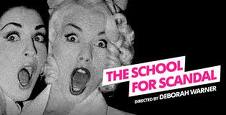
Theatre Review : The School for Scandal by Richard Brinsley Sheridan - Barbican Theatre (dir Deborah Warner 7/6/11)

Deborah Warner is one of my favourite directors. Her vision of Mother Courage at the National Theatre was undoubtedly one of my theatrical highlights of 2009 – musically inspired, funny, biting. She is one of the few directors consistently able to stage exciting and visionary reinterpretations of Shakespeare, such as her big-scale Julius Caesar, and an extraordinary Titus Andronicus. So it was with eager anticipation that I went to see her interpretation of Sheridan’s School for Scandal at the Barbican.


On entering the auditorium to thumping rock music, the actors are taking part in what appears to be a modern fashion shoot, gossiping and taking pictures of the audience with their mobile phones. Signs are held up, which presumably highlight some of the character traits we are about to see in the play. When the action proper begins, Lady Sneerwell (Matilda Ziegler) and Snake (Gary Sefton) are both in 20th Century underwear being dressed with 18th Century clothes. So far, so very Brechtian.

The problem, however, is that this is not a play by Brecht. Brecht’s plays are generally quite linear in exposition, their plot lines relatively simple. This is not the case with Sheridan – his plot lines are famously convoluted, and rely on some heavy exposition early on to make them work. This is where this production failed, on two levels. Firstly, there were too many distractions that diverted attention to what was being explained, and secondly the delivery by several of the cast was so flat that it was difficult to focus attention on the explication. So by the time the action picked up towards the end of the first half, I was utterly bewildered as to what was going on (I was not previously familiar with this work) and the humour was passing me by. This was a pity, as, by the third act (we have the numbers of the acts and scenes on banners on the stage, naturally) the momentum had picked up and the stage-business was becoming very amusing.

At the interval, I repaired to the bar and read the synopsis in the program which enabled me to work out who was doing what to whom and why, which meant that the second half of the performance was significantly more enjoyable than the first – but it was too late for many fellow theatregoers, judging by the empty seats after the break. One shouldn’t need to rely on a program synopsis - if Deborah Warner had focussed attention on Brechtian devices which enabled a clearer exposition of the plot, then this could have been a triumphant production.

It seemed to take the cast a while to get going as well, as if they had been put off too by the silliness at the start. The Surface brothers (Aiden McArdle as the devious Joseph and Leo Bill as the dissolute Charles) stood out. Once the momentum picked up, both extracted maximum humour from their roles, ably and effortlessly assisted by a gruff but sensitive Alan Howard as Sir Peter Teazle and John Shrapnel as Sir Oliver Surface carrying on regardless of what was going on all around him. Gary Sefton proved a visual stand-out in the unpromising role of a drunken Gentleman with elastic limbs and Katherine Parkinson was a suitably flighty Lady Teazle, although generally – and surprisingly - the female characters did not come over very strongly.

Like any good Regency comedy, this production resolves to a satisfactory conclusion, and the second half is splendid entertainment. It is such a pity that so many of the audience had been lost – physically or emotionally – by this point. Sheridan is a playwright who is still funny and relevant today, and this production represents a lost opportunity to bring home this relevance to a contemporary audience. There is nothing wrong with an adventurous modern production, but that cannot be at the expense of proper pacing and clear exposition. It’s such a shame, as this was so close to working so well.

Theatre Review : Government Inspector by Nikolai Gogol - Young Vic (dir Richard Jones 20/6/11)

Comedies of confusion appear to be à la mode in London this summer, but whereas Carlo Goldoni’s A Servant of Two Masters, so successfully transformed into One Man, Two Guvnors at the Lyttleton, is essentially a piece of highly entertaining fluff, Nickolai Gogol’s vicious satire Government Inspector was sufficiently provoking to the Tsarist government for it to ban the play and send its author into exile.


The basic premise is simple. The mayor of a provincial Russian town hears that a Government Inspector is due to visit his town, and is worried that he might arrive incognito. When he hears that a gentleman from St Petersburg has arrived at the Inn he assumes that this must be the Inspector. However, it is in fact the penniless chancer Khlestakov, who is at first bemused when the mayor pays off his debts, but quickly works out how to turn the situation to his advantage when he learns that the townspeople wish to shower him with bribes and the mayor’s wife and daughter are overcome with the wit and sophistication of the gentleman from St Petersburg.

Gogol’s original play is sublime, spearing the corruption and pretensions of mid-19th Century Russia. However, this wonderful new production by Richard Jones, based on a fresh translation by Ian Harrower, takes the play into a new dimension entirely. This is Gogol-as-cartoon, fast and brash and bright and stylish. The set is the interior of a house which disappears rapidly into an impossible perspective, the costumes are from CbeeBees, the characters grotesques. Visually it was superb, every angle and mannerism maximised for comic effect. But it captured the manic surreality of Gogol perfectly, and the exaggerated movement allows the action to hurtle along at a cracking pace.


Louise Brealey (Maria), Doon Mackichan (Anna)
 and Julian Barratt (Mayor) in
Government Inspector at the Young Vic, London


Photo: Tristram Kenton

Kyle Soller as Khlestikov is superb, his increasingly manic machinations driving the comedy, and he is well matched by Doon Mackichan and Louise Brearley as the mayor’s wife Maria and daughter Anna, Anna tottering in her short skirt and high heels or slumped on the seat in teenage ennui, Maria with fan and leg outstretched indulging in “sophisticated” small-talk. The bit when they hear that the so-called Inspector from St Petersberg will stay at their house and both run around screaming is perfect. All the supporting cast are very good, hamming it up for all they are worth, Amanda Lawrence as the inquisitive postmaster in particular.

The only disappointment, however, was Julian Barrett as the Mayor. Barrett’s previous experience on stage is as a comedian, and on television. As far as I can discover, this is his first major theatrical acting role, and one could tell. He looked the part, his movement was very good and some facial expressions very funny, but his delivery was a bit flat and lacked conviction when compared to the manic, exaggerated projection of his fellow actors. In other productions this may not have mattered, but here he was exposed and it left a bit of a hole in the middle of the show.

However, this was the only weakness in a tremendously good production, one which was as visually striking as anything I have seen in years. Fast, funny, clever, stylish, this really demonstrated – vide my comments on Deborah Warner’s School for Scandal – how to make an old play relevant for the 21st Century, as all the youngsters around me seemed to love it.

Sunday, June 19, 2011

Theatre Review : Emperor and Galilean by Henrik Ibsen - Olivier Theatre (dir Jonathan Kent 13/6/11)

The Olivier Theatre is the best theatrical space in Britain, the thrust stage bringing the audience up close to the performers, the sightlines perfect (except from the very back) and the hydraulic revolving stage allowing directors and designers tremendous flexibitity in how they present large-scale dramas. Seldom have I seen it used to better effect than Jonathan Kent's creation of the Roman Empire from glittery Constantinople to darkest Gaul in this striking production of Ibsen's Emperor and Galilean.

Apparently, this is the first time that this sprawling historical drama has been produced on the British stage, Ibsen's original Closet Drama (i.e. having not been written reading and not for performing) about the life of the Roman Emperor Julian the Apostate having been trimmed from a mighty eight hours to much more manageable three and a half. But three and a half hours is a long time to sit in the theatre if the play is a duffer - after all, there must be a reason why it has not been performed over all these years. However, there was no reason to worry. Jonathan Kent and designer Paul Brown were not going to stint on any opportunity to maximise the spectacle on show as the drama moved from the Christian Court of the Emperor Constantius to sacrifices to the gods in Ephesus to the final battle in the Persian Desert.

The play is frighteningly topical. It is an examination of the nature of faith and freedom in the context of State power. Emperor Constantius (Nabil Shaban) has a tenuous grip on a newly Christian Empire, and keeps his nephew Julian (Andrew Scott) under close suveillance. Julian has doubts about his Christian faith, which are confirmed by the pagan priest Maximus (Ian McDiarmid). When the Roman Legions overthrow Constantius and propel Julian to the Imperial throne, he promises a return to the pagan religion whilst tolerating Christianity. However the corrupting nature of power corrodes these ideals, and soon the Christians of Antioch are being subject to persecution. Having been told by Maximus that he will fall on the field of Mars which is in Rome, Julian becomes convinced of his infallibility and invades Iraq. Needless to say, tragedy ensues.

Ibsen refers to this play as his most important work, and one can sense glimpses of his conception of the nature of individual freedom, however the play does not articulate these clearly. Having not read the full script I cannot say if this is a shortcoming on the part of Ibsen or Ben Power who made the adaptation. In fact towards the end, the play sounds like a paean for the Christian faith which I don't think was Ibsen's intention at all. It is structured as a tragedy, but in comparison with Shakespeare's great historical plays (think a combination Richard II's idealism with Richard III's megalomania) the characterisation of Julian falls a long way short, and the tragic denouement is weak.

However, this does not detract from a spectacular theatrical experience. Andrew Scott brings power and presence to Julian and Nabil Shaban is a striking Constantius. The staging is dramatic, beautifully designed with striking use of music, metal and fire. It's difficult to depict pagan celebrations without resorting to cliched cavorting, but the powerful scene where the Roman Army persecutes the Christian villagers in Syrian Antioch had a contemporary resonance which Jonathan Kent could not have foreseen. As the production ended, I was surprised that the audience reaction was somewhat muted. On the contrary, I felt that Jonathan Kent, Ben Power and Andrew Scott had triumphed in making a spectacular, accessible and thought-provoking evening with such difficult material.

Sunday, May 29, 2011

Theatre Review : One Man Two Guvnors by Richard Bean - Lyttleton Theatre (dir Nicholas Hytner 23/5/11)

For me, the acme of theatrical comedy is Michael Frayn’s Noises Off, a structural masterpiece which takes a mundane farce, turns it inside out and builds into a magnificent finalé which cannot be beaten. All other modern comedies are measured against this, and usually fall short by a long way. One Man, Two Guvnors at the National Theatre, however, came very close.

The play is a reworking by Richard Bean of Carlo Goldoni’s “A Servant of Two Masters”, itself a very funny late commedia dell’arte piece – but don’t let that put you off. One Man Two Guvnors simply uses Goldoni’s basic plot – a cheeky chappie with an insatiable appetite gets hired first by one master, then another and has to keep them both going without each other’s knowledge so he can be paid twice. Needless to say, confusion ensues.

One Man Two Guvnors transposes the action from Venice to Brighton, with Francis Henshall (James Corden) in the employ of gangsters Rachel Crabbe (Jemima Roper), disguised as her twin brother, who was due to marry Charlie "The Duck" Clench (Fred Ridgeway)’s dim daughter Pauline (Claire Lams) (though she loves actor Alan Dangle (Daniel Rigby)) - and Stanley Stubbers (Oliver Chris), who has killed Rachel's brother and is in love with Rachel. The plot is taken directly from A Servant of Two Masters, it's complicated and completely irrelevant.

The action revolves round a series of activities that Henshall is asked to do first by one guvnor and then the other. This reaches a crescendo as he tries to serve the same meal to each of his bosses in separate private rooms in a restaurant, with help from a very shaky 87-year old waiter (Tom Edden) and an audience member, whilst satisfying his own insatiable appetite. The result – without giving too much away – is one of the funniest set pieces I have seen for a long time, a masterpiece of timing, slapstick humour and surreality as Henshall gets pulled between one room and the other.

The second half isn't as good as the first, but its still very funny. As in all good farces, the lovers end up with their trousers round their ankles - as in all good Commedia del'Arte, the loose ends all get tied up in the end. There is a bit of self-referentiality when James Corden muses on how his Harlequinesque character traditionally uses the satisfaction of his baser urges to drive the action forward, but this is not aimed at theatrical historians, instead it's just an excuse for lining up another set of gags.

What the line does highlight is that this is not just comedy gold, but actually very clever theatre. Goldoni's original play is never overt, but in fact the plot sticks to its outlines very closely and maintains traditions of Commedia del'Arte - character stereotypes, the breaking down of the fourth wall, the asides to the audience and improvisations (some intentional, some not). The Brighton pub is The Cricketers Arms, from Brighton Rock.

The performances are without exception sensational. I loved James Corden in The History Boys, despaired at some of his subsequent career choices but he is charming, charasmatic and very funny in the lead role. Oliver Chris as the posh gangster Stanley has all the best lines, delivered to perfection, and Daniel Rigby overacts superbly. The skiffle music by Grant Olding and The Craze, ably supported by members of the cast (Daniel Rigby topping everything) is excellent, but the show is stolen by Tom Edden as Alfie the elderly waiter.

This may not be to everyone's taste. If you don't enjoy slapstick, farce or general silliness then it may not be for you. But I don't think that spare tickets for this superb production will be on sale for long. I laughed so much my sides hurt, the man next to me even more so. I hear that addional tickets are coming on sale soon, so I urge you to book up immediately for one of the most enjoyable evenings I have spent at a theatre for quite a while.

Thursday, May 26, 2011

Theatre Review : The Cherry Orchard - Olivier Theatre (dir Howard Davies 16/5/11)

It’s not the plot you remember from Chekhov plays - it’s the tone, the suffocating sense of loss. You think they all take place on still summer days when no air moves – but they don’t, the plays are all spread through the year, but you are left with a feeling, an impression…


More than any other playwright, Chekhov was a visionary. He saw the changes in Russian society hurtle towards him, yet he wrote before the Revolution of 1905 when Tsarist power remained monolithic. It is difficult to watch his plays without the prism of the events that followed, since The Cherry Orchard is a revolutionary play. Ranyevskaya is an absentee landlord, a frivolous, vain woman. She has returned after ten years to her estate simply because she has run out of money – hence the necessity of the sale of the cherry orchard. The new order that replaces the old is a product of economic determinism as much as that of individual will.

Yet Chekhov never preaches. No character is sympathetic, but none are entirely unsympathetic either, all their failings are gently and humorously picked away. You want to give most of them a slap, tell them to get their act together. Its that indeterminacy which is the greatness of Chekhov – you don’t have the bleakness of Ibsen, the characters railing against the moon, or the screaming moral turmoil of Strindberg.

This production captures much of the lightness of Chekhov, but without the suffocating tone. Howard Davies tries to retain the historical context, whilst eschewing Chekhovian clichés. The result succeeds up to a point – it is a clear, lucid production but without anything that sets it apart as being magical. The same can be said of the cast – Zoë Wanamaker is well suited for the role of Ranyevskaya, the headstrong romantic helpless in the face of economic necessity, unable or unwilling to make the decisions she needs to take. Conleth Hill is very good as a ranting Lopakhin, exultant and despairing at his purchase. Best coup de theatre of the evening is courtesy a startling Sarah Wooward as the performer Charlotta, and Kenneth Cranham captures the pathos of the forgotten Firs. All are very good, but the heights remain elusive.

The Cherry Orchard will always fascinate. This is a good production, ideal for someone coming to it for the first time – but it lacks anything to set it above and beyond the several other productions of this play that we have seen in London in recent years.

Monday, May 02, 2011

Theatre Review : Macbeth - Clerkenwell House of Detention (dir Alexandre Wright 28/4/11)

The audience is led through darkened passages past the injured Captain declaiming his praise of Macbeth to a shadowy underground hall where three ghastly, blood-soaked apparitions meet Macbeth and Banquo. The action moves swiftly through the arched chambers as the audience follows, breaking up and reforming like a small flock of starlings as it seeks vantage points. Noises are heard off and some head off in pursuit, but then Macbeth appears, acknowledging the witches' prophesy, and the audience recoalesces around him.

The play is set in the damp and darkened vaults of the Clerkenwell House of Detention, formerly a prison dating back to the seventeenth century. This is the perfect venue for Macbeth, a dark and claustrophobic play, remarkably intimate considering it deals with the affars of Kings. After the opening scenes the witches are lurking in every shadow determining the action of the play, their spirit summoned by the haunting motif that announces their presence. Characters metamorphose from behind pillars and passageways and from within the audience, the darkness and movement conspiring to allow the play to be performed with a remarkable four actors only.

Dominic Allen was the one constant, Macbeth with an evil presence and a sarcastic smile. He was possibly too conscious of the necessity of keeping the up the pace of the production as his lines were delivered slightly too quickly to allow easy comprehension in a difficult space with the shifting audience. He should have followed the lead of James Wilkes' Lady Macbeth, whose pace and delivery was, to my mind, perfect. Wilkes and the other cast members metamorphose easily from one character to another with blood and shadows. The cleverly cut and rearranged text telescopes the action into a mere ninety minutes (farewell to the Porter and to a large part of the interminable scene with Duncan and MacDuff in England). The effect is not to uncover previously unexpored aspects of the play, but to heighten and sharpen the theatrical experience.

The success of companies such as Punchdrunk have made these types of production very popular. They don't always succeed as there is a necessary compromise between comprehensibility, directorial intential and immersive experience. This is as much about the audience's overall experience as the play itself. However Belt Up Theatre succeeded in keeping a young audience largely engrossed and terrified in equal measure in this atmospheric and intelligent production.

Tuesday, April 12, 2011

Theatre Review : The Tempest - Barbican Silk St Theatre (dir Declan Donnellan 11/4/11)

There is a freshness at the heart of Cheek by Jowl’s earthy, physical – but always text-driven – interpretations of Shakespeare, which is why Declan Donnellan’s company is now an international powerhouse, constantly performing their repertoire of mainly classical works across the globe. This latest version of The Tempest at the Barbican Silk St Theatre, performed in Russian by the Chekhov International Festival Theatre, demonstrates Cheek by Jowl at their best.


Nick Ormerod's set is minimal, bare boards and a curved back wall with three doors. An aged, weatherbeaten Prospero (Igor Yasulovich) conjours the winds and the two side doors open to reveal little vignettes of the sailors fighting the storm. In an arresting image, the centre door opens to show Ferdinand (Yan Ilves) upside down as if he is swimming underwater. The storm subsides and Miranda (Anya Khalilulina) enters - beautiful, naïve and wild, running on two feet then crouching and crawling on all fours. However, as the stern Prospero prepares her to meet Ferdinand, his tenderness is evident as he combs her hair and tells her how he came to be on the island.

This is classic Donnellan – the set which just contains enough for the Director to use imaginatively, the physicality of the movement, the attention to the text and the true sense of the words, even if they have been cut and rearranged in their translation to Russian and back. One gets a sense of the rough rhythms of the Russian verse even whilst one is straining one’s neck to read the surtitles.

Ferdinand (Yan Ilves) piles logs (in the
form of Ariel (Andrey Kuzichev))
at the behest of Prospero
Water is a recurring theme, poured liberally around the stage. It rains on the sailors in the storm. Multi-facetted Ariel (Andrey Kuzichev), in his multiple forms, tortures Trinculo (Ilya Iliin) and Stephano (Sergey Koleshnya) by pouring water on them in ever-more imaginative ways. Miranda and Ferdinand are both cleansed in water, Miranda innocently stripping off her shirt before Caliban (Alexander Feklistov), whilst Prospero purifies Ferdinand before his marriage to his daughter.

The production pays witty homage to its Russian roots in the usually-tiresome masque scene, where Iris, Ceres and Juno are Russian peasant women joined by sickle-wielding dancers sing the praises of increased agricultural production whilst striking poses familiar from Social-Realist posters and stamps. And when Trinculo and Stephano are offered new clothes, they dress in suits and sunglasses like Russian mafiosa in a glitzy Moscow shopping mall, discovering to their delight that their credit cards work.

From being severe at outset, by the end of the play Prospero has expended his fury on those who betrayed him. He forgives the Duke his brother. He frees the faithful Ariel. And even at the end, before leaving the island, Miranda rushes back to Caliban and throws her arms around his neck. As we leave, Ariel is resting his hand on Caliban’s head in a gesture of compassion.

We have hope for those who remain on the island – perhaps more hope than for those who return to Italy. Prospero has abjured his rough magic – he must now rely on Ferdinand and the audience for succour and protection as he returns to Milan where every third thought will be of his grave. The magic and innocence of the Island has passed, he must return to so-called civilization to end his days, and we must return ourselves to the quotidian after losing ourselves in this spellbinding production.

Tuesday, January 18, 2011

Theatre Review : Small Hours by Lucy Kirkwood and Ed Hime - Hampstead Downstairs (dir Katie Mitchell 17/1/11)

The audience is restricted to 25 for this intimate site-specific piece in the Hampstead Theatre's Michael Frayn space. One is asked to take off one's shoes, and sit on the furniture around the edge the living room of an undistinguished IKEA-furnished flat.

A woman stands up, sniffing. One immediately suspects that she may have an issue with 25 newly released pairs of feet, but, no, she sprays some perfume into the centre of the room. One of the benefits of the claustrophobic staging is that one can smell the cheap perfume.

Something is disturbing her. She turns on the radio - Severe weather warning in Scotland. She phones but rings off - after all, it is about 3am in the morning. Someone calls her - father? boyfriend? She says no I don't have a boyfriend. Does he want to go to see The Social Network this weekend? We're only getting half this conversation.

She rings off, disturbed. She slowly and carefully puts her make-up on (at 3am - before going to bed? - no, she's putting her coat on. So is she going for a walk? Is she on the game?) and is about to go out when a baby cries. Is it her baby? She wouldn't go out and leave the baby? Would she? She ignores its cries - but, wait, she's going to it, and returns with a nappy sack. She sniffs again and sprays her perfume - is that baby's nappy I can smell now, or is that autosuggestion?

To say much more would give the game away - suffice to say that the director is Katie Mitchell, so she is a master at using sound to create unsettling tension. Noises we cannot ignore - telephones, babies' cries, Chemical Brothers cranked up at an unfeasible hour in the morning (turn it down think of the neighbours we shout inwardly - no, don't put it on again...).

This is a portrait of isolation - the woman (played by Sandy McDade with proper restraint in her despair) is by herself in the small hours apart from her loved ones, failing to cope. What her backstory is we never know. Fill in the gaps from the hints provided. What has pushed her to the edge? - again we don't know. What is the resolution? It is left ambiguous.

Is this a worthwhile piece of experimental theatre? Undoubtedly yes. The claustrophobic staging is an integral part of the theatrical experience, immersing the audience into the sights, sounds and smells of the woman's flat. But did it work as drama? To a certain extent. For a piece that lasts only an hour it has its longueurs, and its finale is so underplayed that there is a temptation to say is that it? But it is a play that reverberates as one reflects upon it - the unanswered questions, the heightening tension, the soundscape, the ambiguous conclusion - and as I sit here writing this review I realise that Katie Mitchell has got to me once again.

Sunday, January 24, 2010

Theatre Review : Waiting For Godot by Samuel Beckett - Theatre Royal Haymarket (dir Sean Matthias 21/1/10)

All these years of theatregoing yet this was my first experience of Godot, indeed of any Beckett, and unlike Godot himself it was worth the wait.

Vivian Mercier's description "a play in which nothing happens, twice" cannot be bettered. Two cantankerous old gentlemen of the road (Ian McKellen as Estragon and Roger Rees as Vladimir) waiting and bickering and contemplating the point of their existence. Their equilibium, such as it is, is disturbed by the arrival of Pozzo (Matthew Kelly) dragging Lucky (Ronald Pickup) on the end of a rope. Then they leave. The next day, Lucky is dragging a blind Pozzo. Godot never arrives.

Reality is fractured, shifting. Vladimir and Estragon don't know what Godot looks like, or why they are waiting for him. Pozzo can't remember meeting them the day before. Estragon can't remember their meeting either, although he bears the marks where Lucky had kicked him. Vladimir thinks that the tree has sprouted leaves overnight, but Estragon cannot remember.

It may be nihilistic, but it's never bleak. "That passed the time" says Vladimir. "It would have passed in any case" retorts Estragon, wanly. The absurdity is well-judged - amusing yet alienating, never overplayed.

The cast is excellent. Roger Rees and Ian McKellen handle the dialogue well with sure timing in this preview production, Rees' Vladimir has energy and traces of optimism but lacked force of delivery. He is upstaged by McKellen who manages to elicit an indefinable sadness from Estragon whose memory is starting to cloud. Ronald Pickup delivers Lucky's speech with speed and aplomb, but Matthew Kelly is once again a scene-stealer, perfect as the big, bombastic, demented Pozzo in Act One. Beckett doesn't leave much scope for stage design, but this was done well, an industrial wasteland, stark and threatening.

Two downsides to mention. £5 for a program which contained a two-page article by Simon Callow, a chronology and a cast-list which is simply not good enough, and a choreographed encore with a dance routine which was cringeworthy. What would have happened if we hadn't applauded? Fortunately for all, not much chance of that in this excellent production.

Theatre Review : The Habit of Art by Alan Bennett (dir Nicholas Hyter 11/1/10)

If genius may be defined as someone who somehow manages to both have his cake and eat it, then Alan Bennett certainly comes close in his latest collaboration with Nicholas Hytner at the National.

It's all in the structure. A theatre troup rehearses a play about a fictional meeting between W S Auden and Benjamin Brittain in Auden's rooms in Oxford shortly before their deaths. A simple play about two of Britain's leading artists of the 20th Century had many possibilities: the difference between composing music and poetry; the changing attitude to homosexuality in the 20th Century; the contrast between the buttoned-up Brittain and the uninhibited Auden to name but a few.

But Bennett probably realised that this would provide arid fare. So by not just framing but immersing the inner play ("Caliban's Day") within the rehearsal studio he liberates his material, giving scope for the actors to bicker with the playwright, the Assistant Director and each other and thus provide a wry but very funny commentary on the nature of the theatrical process. In doing so he overcomes some of the portentiousness which is still residual within Caliban's Day, and gives himself scope for a multitude of scatalogical observations which one couldn't realistically envisage when Benjamin Brittain was on stage.

Richard Griffiths and Alex Jennings have no need to break sweat playing Fitz/Auden and Henry/Brittain respectively. Griffiths plays up to the fact that the avuncular Fitz is dissimilar to Auden both in face and form, although Jennings' camped up Henry looks very similar to Brittain. Adrian Scarborough plays their mutual biographer Humphrey Carpenter, sent by BBC Oxford to interview Auden and mistaken by Auden for a rent boy, and Frances de la Tour is excellent as the Assistant Director, ensuring that egos remain massaged, self-esteem boosted and the malign presence of the playwright (Elliot Levey - not a bit like Alan Bennett!) restrained from insisting on the inclusion of some of the worst verse ever to have graced the boards of the Lyttleton.

The structure softens the fact that both the protagonists in Caliban's Day were both pretty unattractive characters. When Brittain cut a friend for slights real or imagined it was for life. Auden's personal hygene (dwelt upon in lurid detail) left everything to be desired. Whilst they had collaborated - notably on Night Mail - in the 1930's, the possibilty of Brittain travelling to meet Auden towards the end of their lives could not realistically be entered into. But in this transparently artificial setting, the rendezvous can take place - although as the focus moves from the production of the play to the inner play itself, the pace drops, the laughs dry up and conversations about the nature of Art, and the relationship between the artists, come to the fore.

It makes a well-balanced whole: funny - both filthy and ludicrous in places - but also addressing some big ideas. It is Bennett's peculiar genius to make the Big Questions about the nature of art, history, sexuality so entertaining and accessible.

Thursday, January 14, 2010

Theatre Review : Cat on a Hot Tin Roof by Tennessee Williams - Novello Theatre (dir Debbie Allen 4/1/10)

There's something going on here I don't understand. Why was the theatre half-full for this production? OK, so it was just after New Year and it was cold - but it was before January's snows descended, and further reductions in prices have just been announced. This looked as if it had all the boxes ticked for a sell-out - a transfer of a top Broadway production, a well-loved film star in James Earl Jones, a TV star from a popular series in Adrian Lester, consistently good reviews, good marketing with James Earl Jones doing the TV sofas and the Underground covered in posters.

So why is this not packing them? Is it that Tennessee Williams' reputation is for intense, shouty plays with a lot of angst and not many jokes? If so, that is very unfair, as Cat On a Hot Tin Roof may be intense, but it is also consistently funny as well. Is there some British distaste at the transposition from a Southern white family in the 50s to a black family in the 80s? Once again, that would be very unreasonable, as the transposition is virtually seemless to anyone who is not familiar with the original text. It's certainly not as dramatic as the Moliere being updated to contemporary London, as is happening across the city with The Misanthrope.

It certainly can't be anything to do with the cast or the production - they are all consistently good, while James Earl Jones excels as the odious Big Daddy. He has the presence, the charisma of the patriach, swearing testily at the family sycophants celebrating his birthday. Yet he tries to connect to his ex-sports star son Brick, intent on drinking himself to oblivion. Adrian Lester hits the emotional high notes well, but didn't convince as a seasoned drinker - he always seemed too clean cut and in control. That being said, his relationship with the sinuous, sexy Cat, Sanaa Lathan, was finely drawn.

This didn't draw you into the vortex in the same way that Streetcar at the Donmar did earlier this year - this is as much the theatrical dynamics of the Donmar's claustophobia as it is about Rachel Weisz's multilayered Blanche Dubois - but it certainly packed a hefty punch.

So why the poor turnout? Two reasons, possibly. A first is that there seems to be a lot of quality drama in the West End at the moment, and the regular theatregoers who go to such productions have difficulties stretching to many evenings out at West End prices. The second reason may be more complex. We are now so familiar with black faces on the British stage that it has long since ceased to be a matter worth commenting upon - I've see Adrian Lester himself play both Henry V and Hamlet, excellent in both roles, and the fact that he was black was never an issue. Could there be some sort of a subconcious reaction on this side of the Atlantic to the fact that this is an all-black production, not through any prejudice on the part of your typically white middle-class London theatre audience, but because this is felt to be a bit unnecessary, a bit old-fashioned, and that we have moved beyond the place where we need all-black productions? I don't know. I do know that the transposition is worthwhile because it works and that those who have chosen to give it a miss will be missing out on an excellent evening.